Urban Solar Carver
GPU-accelerated generation of maximum developable building volumes that protect solar and daylight access in urban environments.
USC follows a subtractive logic: a theoretical maximum volume is progressively carved by casting rays from protected surfaces toward the sky, removing voxels that obstruct solar/daylight access beyond a configurable threshold.
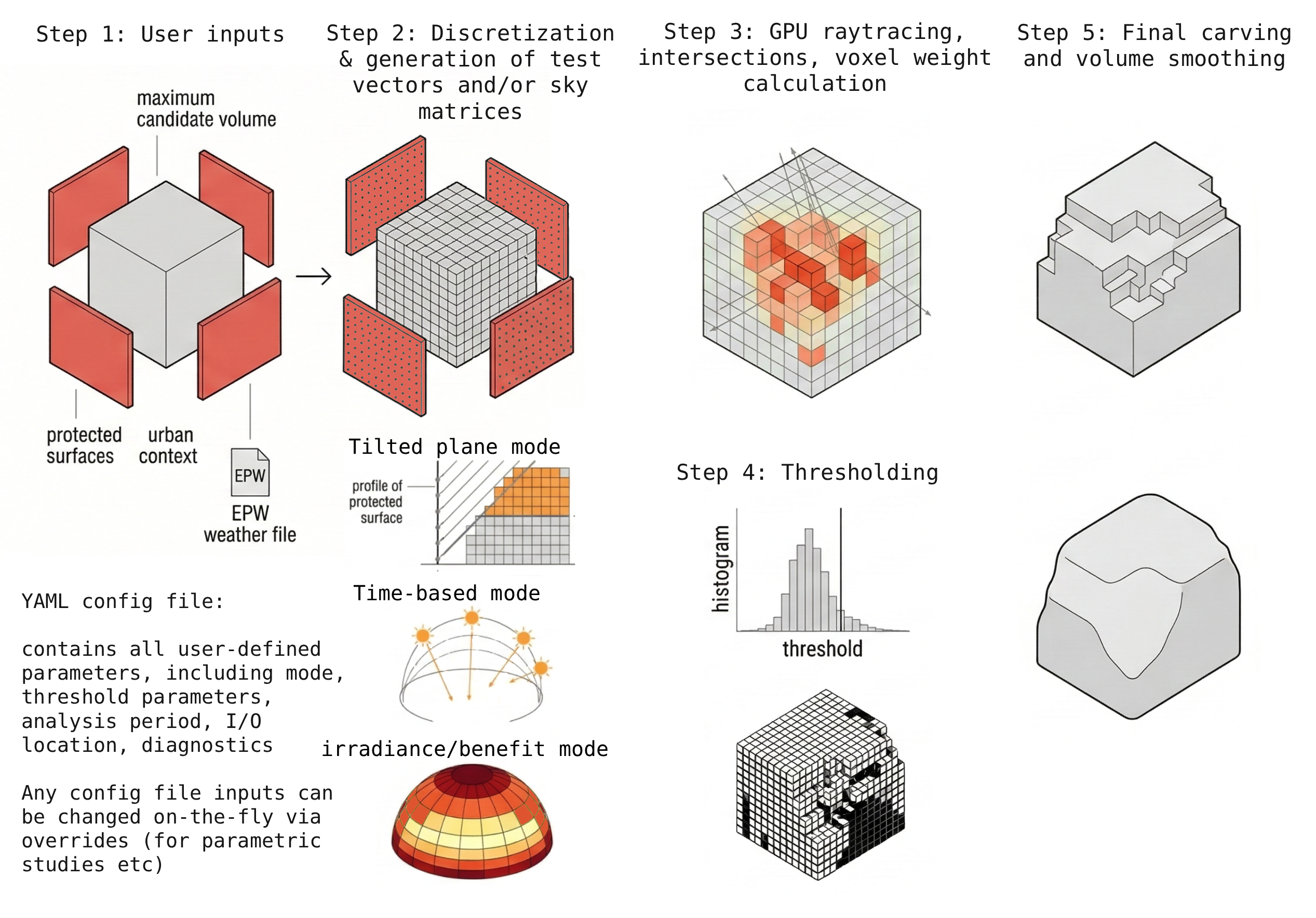
Overview
- 6 carving modes covering solar access, passive heating, daylighting, and radiative cooling
- 3-stage pipeline (preprocessing, thresholding, exporting) -- each stage independently re-runnable
- GPU-accelerated ray tracing via NVIDIA Warp (DDA kernel), with CPU fallback
- Grasshopper plugin (15 components) for Rhino 3D integration
- Python API, CLI, and Jupyter notebooks
Pipeline
Input (PLY meshes, EPW weather, YAML config)
    |
    v
Preprocessing ── scores.npy, voxel_grid.npy
    |
    v
Thresholding ─── mask.npy (binary carving mask)
    |
    v
Exporting ────── carved_mesh.ply
Each stage reads the previous stage's manifest, so you can re-run thresholding with different parameters without re-computing scores.
Documentation
- Getting Started
- Installation -- setup via
setup_env.pyor manual install - Quick Start -- Python API, CLI, and notebook tutorials
- Configuration -- YAML config reference with per-mode examples
- Installation -- setup via
- Carving Modes -- the 6 analysis modes explained (tilted_plane, time-based, irradiance, benefit, daylight, radiative_cooling)
- Grasshopper Plugin -- Rhino 3D integration, component list, daemon setup
- Project Map -- every file and directory in the repository
- API Reference -- full function signatures, parameters, and return types (auto-generated from docstrings)
- Changelog